
Understanding Charleston County Releases
A release ends one custody episode. It does not always mean the person returned to the community. Sheriff Al Cannon Detention Center, often called SACDC, may release someone after bond, personal recognizance, dismissal, time served, or completion of a local sentence. It may also transfer a person to the South Carolina Department of Corrections, another county, the U.S. Marshals Service, or immigration authorities. The booking status, release date, reason, and destination must be read together.
Once a person leaves SACDC, the live inmate list may no longer be the useful view. The official Charleston County inmate portal has a Show Past Bookings option for prior custody records. A state-prison discharge belongs in the separate SCDC Released Inmate List. Federal and immigration custody require their own systems. This division prevents a county transfer from being mistaken for a return home.
- Discharge
- The formal end of a custody or supervision term.
- Time served
- A sentence satisfied by time already spent in custody.
- Detainer
- A request or hold that may send a person to another authority.
- Expungement
- A court process that can remove qualifying records from public access.
Charleston County Release Paths
The label on a Charleston County release record changes what should be checked next. Bond and personal recognizance allow a pending case to continue outside jail. Probation is a court-ordered community sentence. Parole is conditional release from an eligible prison term. A transfer closes the SACDC segment but begins or continues custody elsewhere.
| Release path | Meaning | Best next record |
|---|---|---|
| Bond or recognizance | Release while the case remains open | Past booking and court docket |
| Time served or local term | Local sentence has been satisfied | Release record and sentencing order |
| Probation | Court supervision in the community | PPP supervision search and court file |
| Parole | Conditional state-prison release | SCDC release list and PPP |
| Agency transfer | Custody continues elsewhere | Destination agency record |
Charleston County Release Record Fields
A complete request should identify the custody episode and ask for the fields needed to distinguish release from transfer. The public portal confirms Booking Status and Release Date, while a narrow records request can seek the actual time, release authority, and destination if those items are maintained and releasable. A court entry helps explain why release was authorized but may not record when physical processing ended.
| Field | What it shows |
|---|---|
| Name and identifiers | The person tied to the booking, including inmate or booking number |
| Admission information | Booking date, time, and admitting or arresting agency |
| Charges | Allegations tied to that custody episode, not the final outcome |
| Booking status | Whether that booking remains active or has closed |
| Release date and time | When SACDC ended the custody segment |
| Reason or authority | Bond, sentence, court action, or another recorded basis |
| Destination | Community release or transfer when maintained and releasable |
A booking photograph identifies the booking. It does not prove guilt, disposition, or release by itself. Match it with Booking Status and Release Date, then follow the charge into the correct court system.
Request Charleston County Release Records
Start with the sheriff's public portal and ask Records whether routine access can supply the item. If not, use the Sheriff FOIA form or the county online FOIA portal. Narrow language reduces search time and helps the custodian locate the right booking.
- Give the full name, inmate or booking number if known, and the arrest or booking date.
- Name the records sought: booking record, status, actual release date and time, release reason or authority, destination, charges, and photograph.
- Ask for electronic delivery and an estimate before work above a chosen amount begins.
- Keep the submission and compare the response with the correct court disposition.
South Carolina FOIA generally requires a written determination within ten business days for records less than two years old and twenty business days for older records, excluding the request day and weekends or legal holidays. Production follows within the statutory period after that determination. The county fee schedule lists black-and-white copies at $0.20 per page, color copies at $0.50 per page, and search, retrieval, and redaction at the prorated pay of the lowest-paid capable employee. A deposit of up to 25 percent may be required.
Charleston Release Access Rules
South Carolina Code Chapter 30-4 governs public-record access. Section 30-4-30 also requires records identifying people confined during the prior three months to be available for in-person inspection during operating hours without a written request. That rule is an access floor, not a promise that the website retains every booking for three months or that the underlying record is destroyed afterward.
Juvenile, sealed, expunged, exempt, and nonexistent information cannot be supplied merely because it was requested.
Find Released Charleston County Inmates
Begin with the agency that owned the custody event. Use a full name plus age or birth year, booking date, inmate number, SID, SCDC number, or federal register number. A charge alone is not a safe identifier. The following order covers local, state, supervision, court, and federal paths without treating roster absence as proof.
- For SACDC, enable Show Past Bookings and search by inmate number or name. Compare the photo, status, date, and charge details.
- For state prison, use the SCDC Released Inmate List rather than the current incarcerated search.
- Check PPP when parole, probation, or other community supervision may follow.
- Use the correct Charleston court index to find bond, disposition, sentence, or commitment.
- Use VINELink for a recent event alert, BOP for a federal prison release, and ICE or federal court channels when those agencies held the person.
- Request the booking-and-release record when the public result is absent or unclear.
A released person usually leaves the live roster. A missing name can also reflect the sheriff's deliberate publication delay, a spelling mismatch, or a different custody system.
The county portal works best as a named-person search. Enter an inmate number when it is known. Otherwise, use at least three characters of the last name and add the first name, booking dates, or arrest dates to separate similar results. Sounds Like can help with uncertain spelling. Open the booking before drawing a conclusion, because the search list alone does not show the whole custody episode.
The official portal image below shows the controls used to reach current and past Charleston County bookings. It comes from the Charleston County inmate search.
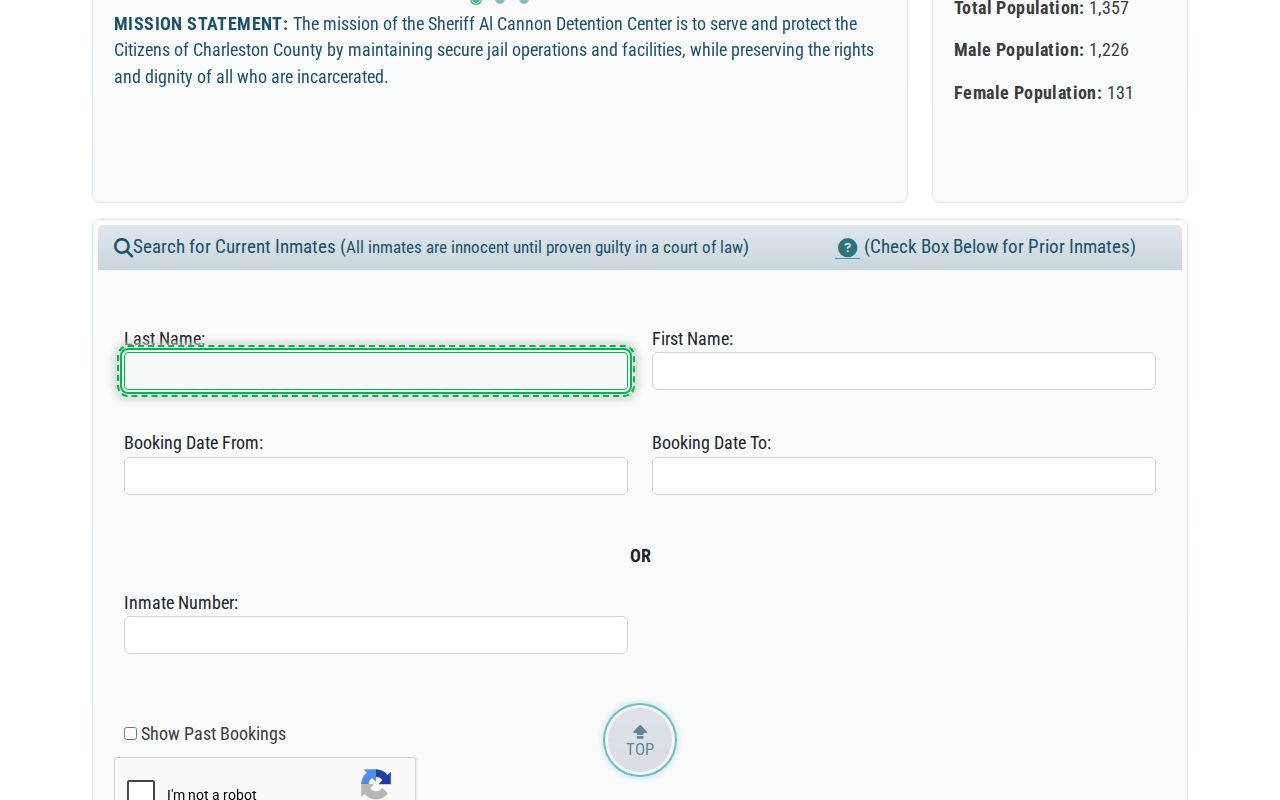
Show Past Bookings is the key control for a person who has already left SACDC. Booking and arrest date fields narrow when the event began, but they do not create a list filtered by the date of release.
SCDC Charleston Release Search
South Carolina separates current and released state-prison records. The ordinary incarcerated search covers people in SCDC custody as of midnight on the prior day and excludes released offenders, county sentences, and juveniles. For a completed state-prison event, use the SCDC Released Inmate List.
| Input or field | Use |
|---|---|
| Release date from/to | Required date range for the event |
| County | Select Charleston or all locations; this is not proof of physical release site |
| SCDC ID and SID | Compare state identifiers |
| Release date/type | Records the SCDC custody event |
| Detainer | May signal a handoff rather than community return |
| MSO | Most serious offense shown in the result |
The SCDC current-search disclaimer explains the custody limit. The manifest image below shows the public search interface used for current state custody, not a Charleston jail roster.
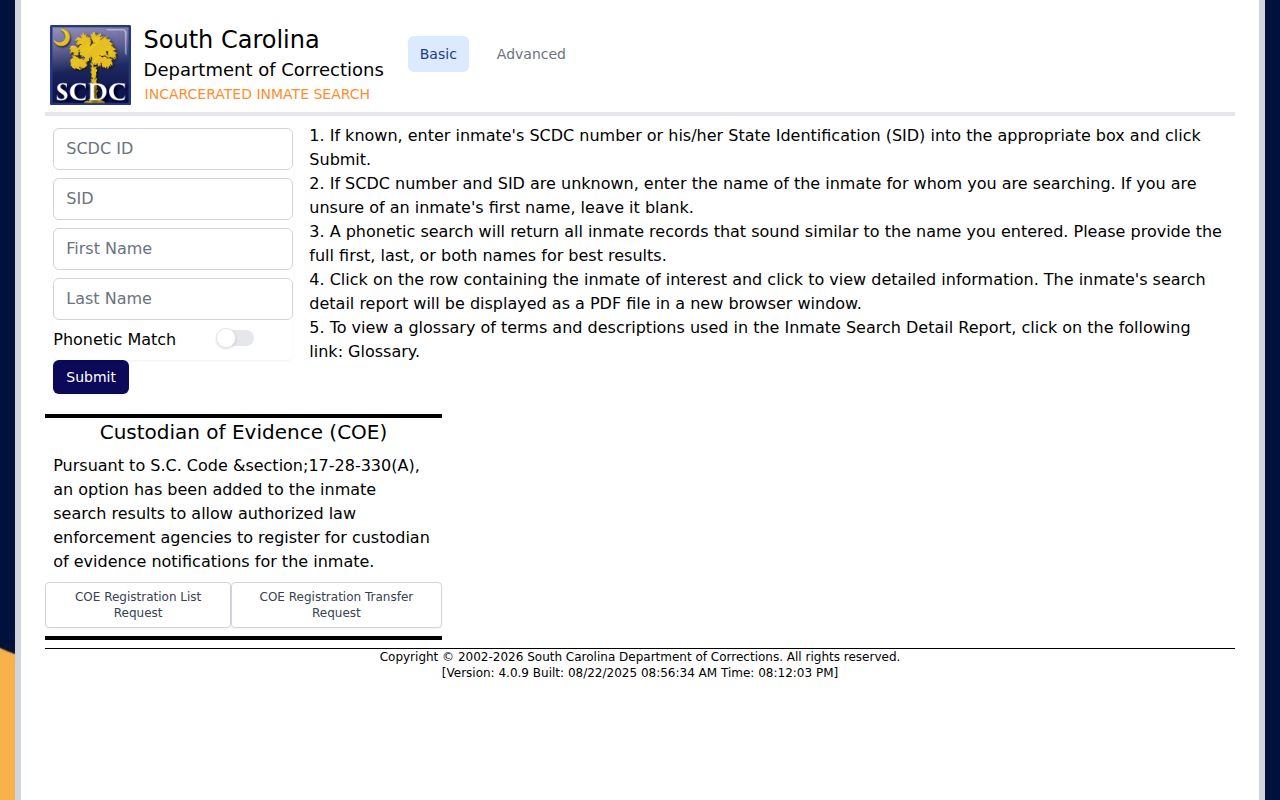
After release, move to the dedicated released list and verify any detainer or destination with SCDC records.
Charleston County Recent Release Limits
Charleston County did not publish a dedicated rolling 24-hour or 72-hour release feed in the interface reviewed on August 1, 2026. The portal instead provides booking and arrest date fields plus Show Past Bookings. Those date filters do not equal a release-date filter. Someone booked weeks ago and released today can be missed by a search limited to today's bookings.
The sheriff intentionally delays web and app booking posts by a short, unpublished interval. A physical list printed at 9 a.m. each day is placed near the SACDC visitor log and may be viewed but not copied. For a named person, the past-booking search and a narrow records request remain stronger than an improvised date window.
Charleston Post-Release Supervision Records
The South Carolina Department of Probation, Parole and Pardon Services keeps the statewide community-supervision search. Probation is imposed by a court. Parole is conditional release from an eligible prison sentence. PPP data reflect the prior day, and completed supervision may disappear, so a no-result does not prove there was no supervision or that discharge occurred on a certain date. The Charleston post-release supervision record should be confirmed through PPP and its local office.
Charleston Release Alerts and Federal Records
South Carolina VINELink can show a recent custody status or event for a specific person when the responsible agency participates. Register on the matching record for an available release or transfer alert. VINE is a notification system, not a permanent history, and a no-result is ambiguous.
For federal prison, search the BOP Inmate Locator by register number or personal details. A released result can show a date, but release from BOP custody may be followed by federal supervision. ICE's locator covers eligible current or recent immigration detention. A Charleston handoff to USMS or ICE is not a community release.
The manifest image shows the BOP locator route used for federal custody records.
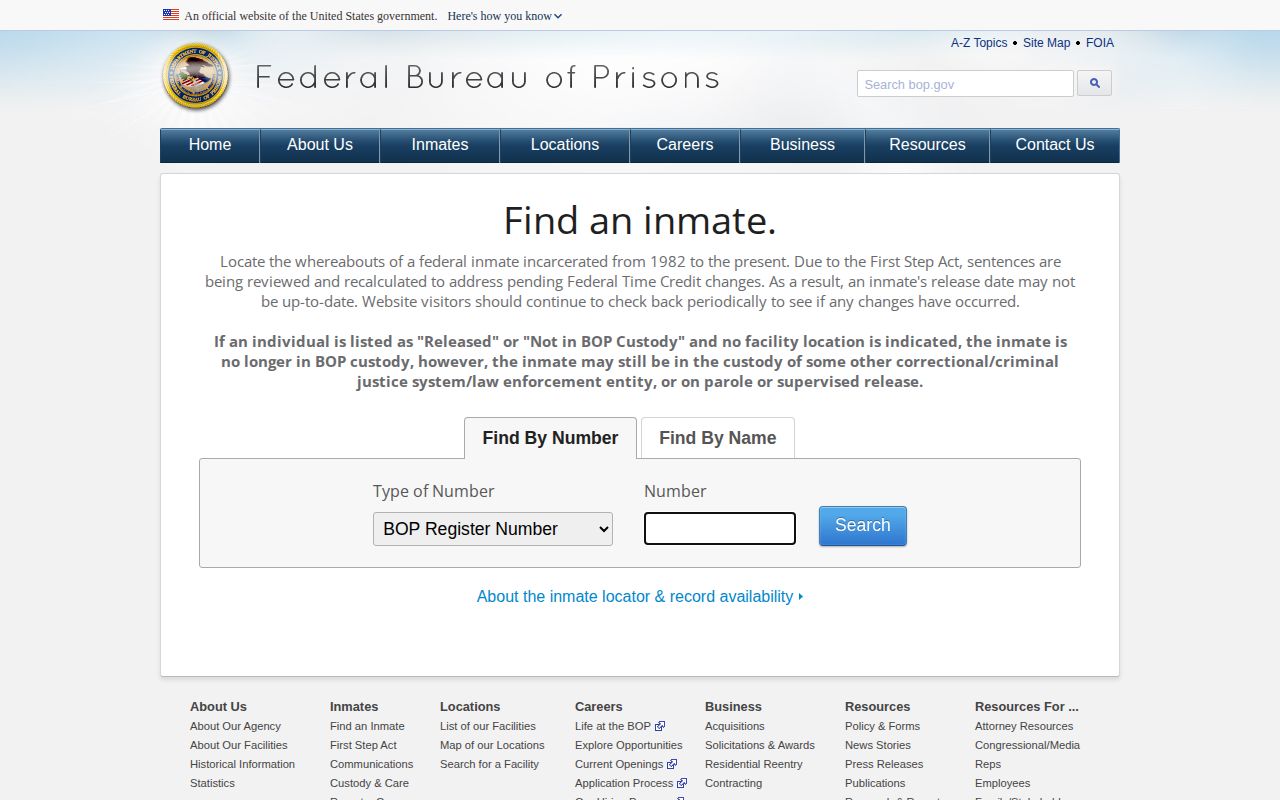
Federal court dockets and the receiving agency should resolve any conflict in custody status.
Charleston Released Versus In Custody
Each system answers a different custody question. Match the person to the owner before interpreting a result.
| Status | System | What it can establish |
|---|---|---|
| Current county jail | SACDC inmate portal | Active booking, subject to publication delay |
| Released county booking | Show Past Bookings and sheriff records | Booking Status and Release Date, plus requested details |
| Current state prison | SCDC incarcerated search | Current SCDC custody as of prior midnight |
| Released state prison | SCDC Released Inmate List | Release date, type, identifiers, and detainer flag |
| Federal prison | BOP locator | BOP custody or covered release date |
Charleston County Release Facilities
Sheriff Al Cannon Detention Center is the adult county jail. Its releases may lead to the community, SCDC, another jail, or a federal or immigration authority. The Charleston County Juvenile Detention Facility is separate. Juvenile information does not belong in the adult portal and must be handled through authorized juvenile court, counsel, guardian, or facility channels.
Charleston Release Bond Handoff
Charleston has a documented paper step for personal-recognizance release. Counsel or family receives a release letter with the PR Bond Form and takes it to SACDC. The defendant signs the conditions. Surety may involve cash or cashier's check, a bondsman, or qualifying Charleston County real property. Percentage cash applies only when the order authorizes it.
That paperwork supplies legal authority but does not complete physical processing. Staff must still resolve other holds or warrants. Follow the bond entry into the court docket and use the jail record for the actual release event.
Charleston County Short Release Stays
The Charleston CJCC 2025 Annual Report counts 9,327 unique people released from SACDC and describes 6,028, or 65 percent, as released in 24 hours or less. A related chart labels its series “under 48 hours,” including the same 6,028 figure for 2025. Both descriptions should be preserved rather than silently treated as identical measures.
High short-stay volume explains why the sheriff's delayed web posting matters. A person can finish a brief custody episode before the booking appears online. The daily lobby list, direct confirmation, and later past-booking result close that gap.
Charleston Jail Property Release Rules
SACDC residents can authorize another person to collect valuable property or cash during two daily windows through a signed Valuable Property/Cash Release Form. Money is issued as a check in the resident's name, and restrictions apply after account transactions. The official property notice gives the detailed rules.
These are property-release windows. They are not inmate release-processing times and should never be used to predict when someone will leave custody.
Charleston Release Reentry Support
SACDC added a second re-entry specialist in 2025. Charleston's PIER program is a long-running partnership among the Detention Center, Bond Court, and Charleston Center. The county describes about twelve weeks of program involvement followed by outpatient care. This is a local service path after custody, not a public release-status field.
Participation should never be inferred from a booking result. A person seeking program information should use the responsible county provider, while anyone verifying custody should stay with the jail record, court order, or supervision record. Keeping those tasks separate protects the meaning of both records.
Charleston Release Court Paths
Charleston's court records are split among Circuit and General Sessions, Summary or Magistrate, municipal, Family Court, and federal systems. Bond Court activity can transfer into General Sessions. Search the county court-services directory by the case number, charge, and assigned court rather than stopping after one missing name.
The court file explains legal authority, such as bond, dismissal, sentence, or time served. The jail record confirms when custody ended. Pairing both avoids confusing an order with the later physical release.
Charleston Release Facility History
The sheriff's detention page traces SACDC to the original 1966 jail, expansions in 1994 and 2010, and removal of modular units and the former Work Camp in 2020. The current description covers four buildings and a capacity of 1,693. Older records may therefore use facility descriptions that no longer match today's footprint.
Missing Charleston Release Records
The Ninth Judicial Circuit Solicitor administers local expungement applications and lists a $250 administrative fee with stated exceptions. Under Section 17-1-40, a qualifying order reaches booking records, bench warrants, mugshots, and fingerprints. Covered agency copies are sealed for the statutory period and later destroyed under the law's terms.
A missing historic booking or image can thus be lawful. It does not always mean the portal failed, and release alone does not make a case eligible for expungement.
Eligibility is case-specific. The Ninth Circuit page lists paths for qualifying nonconvictions, summary convictions, Youthful Offender Act matters, specified drug or check cases, conditional discharge, and some juvenile matters. Some categories have exceptions to the published administrative fee or other costs. The official application route or legal counsel should be used instead of assuming that time since release determines eligibility.
Sealed records also change how agencies answer later requests. The law can require identifying details to be removed from an otherwise responsive incident report. A custodian may therefore return a redacted document, confirm that no public record is available, or cite a court restriction. Ask for the written basis when material is withheld, then use the official review process if clarification is needed. Do not substitute an old copied image for the current government record.