
Charleston Projected and Actual Dates
Three dates are often confused. An actual release date records an event that already happened. A scheduled or projected date is an agency's current calculation for a sentenced person. An earliest-possible estimate is a hypothetical date based on assumptions. South Carolina's public release calculator belongs in the last category. It must not be presented as the official projected release date for a named person.
A pretrial detainee at Sheriff Al Cannon Detention Center usually has no sentence-expiration calculation. Bond, a court order, dismissed charges, time served, another agency hold, or a later sentence may control the exit. A locally sentenced person has a calculation based on the commitment, applicable jail credit, and SACDC records. A state prisoner has an SCDC sentence computation. Parole eligibility is a separate milestone and does not guarantee release.
County release can also mean transfer. If SACDC sends someone to SCDC, another county, ICE, or U.S. Marshals custody, the Charleston County segment ends while confinement continues. Read the release type and destination before calling the event a return to the community.
Find Charleston Projected Release Dates
First identify the custody system. Searching SCDC for a person held only at SACDC leads to the wrong record, while a county past booking cannot calculate the end of a state-prison sentence. Also determine whether the person is pretrial or sentenced before looking for a date.
- Confirm the current facility and match the person by name and identifying number.
- For SACDC, review the court order and ask detention Records for scheduled or actual release information. Ask whether another hold exists.
- For a current SCDC prisoner, inspect the live SCDC person profile for any date actually displayed, then confirm with Inmate Records at 803-896-8531.
- Use the state calculator only to study general statutory assumptions before sentencing. Save every input and the calculation date.
- For a person already released from SCDC, use the released list's actual Release Date and Release Type.
- Use VINE for an event alert, not for sentence computation.
Research did not verify a named public SCDC field called Projected Release Date or Tentative Release Date. Do not promise that label. The live profile may expose useful case data, but SCDC Inmate Records is the proper confirmation source. The Charleston County release-record search covers the separate path for an actual SACDC release.
The official SCDC incarcerated-offender search supplied this captured current-custody view.
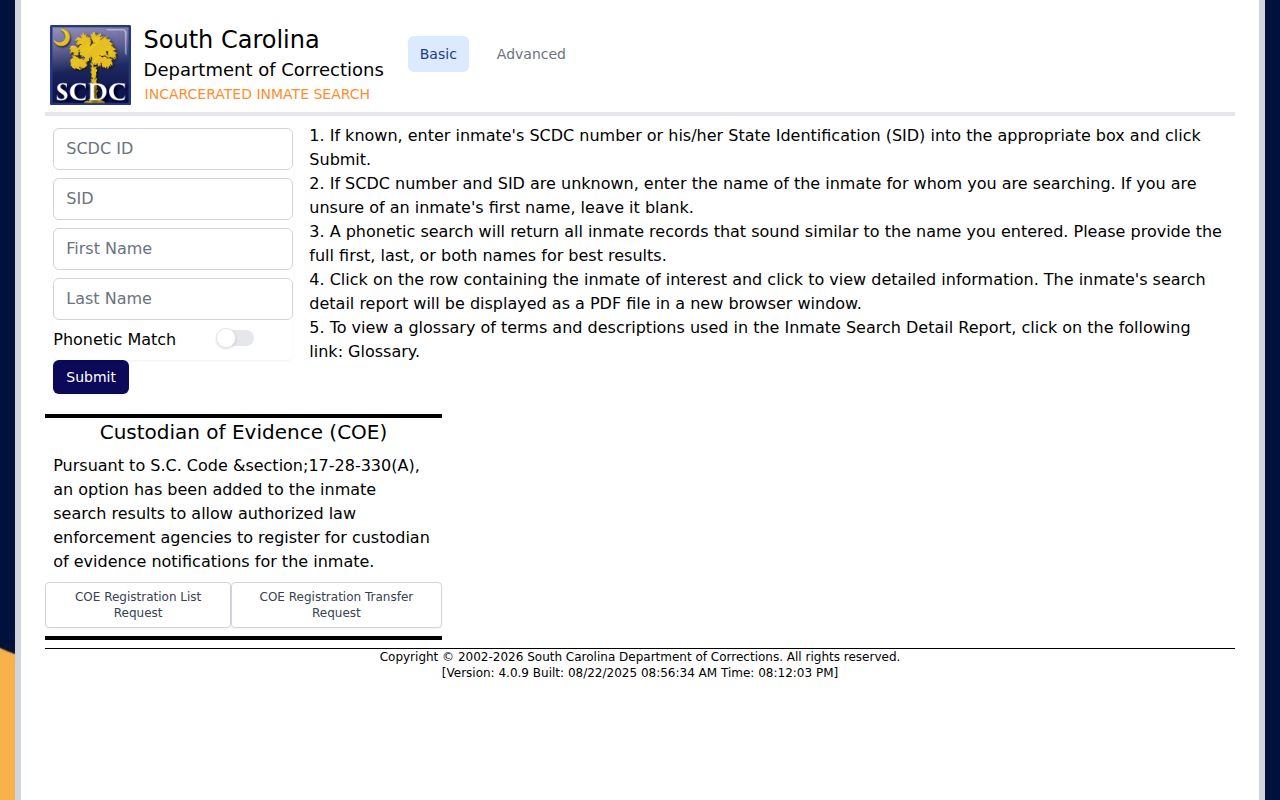
A released person does not remain in this current-custody search, which is why the separate released list is needed after discharge.
Note: A court's sentence and the agency's later sentence computation serve different roles, so compare both before relying on a date.
Charleston Release Credit Rules
South Carolina does not use one credit rule for every sentence. Under section 24-13-210, an eligible SCDC inmate serving a non-no-parole term receives 20 days of good-conduct credit for each month served. A no-parole inmate receives three days per month, subject to statutory floors and exclusions. A local detention sentence receives one day for every two days served. Discipline can cause credit forfeiture.
Section 24-13-230 permits work or education credit for eligible non-no-parole SCDC terms at up to one day for each two days of work or study, with a combined maximum of 180 days per year. For a no-parole term, the statute uses six days per month and a maximum of 72 days per year without allowing credits to cross the required floor. Local productive-duty credit can be up to one day per two days. Eligibility, successful participation, and offense restrictions matter.
Section 24-13-150 requires a person convicted of a defined no-parole offense generally to serve at least 85 percent of actual imprisonment before early release, discharge, or community supervision. Good-conduct, work, and education credits cannot push the date below that floor. The separate 80-percent figure in section 24-13-125 concerns work-release eligibility. It is not a general release-from-sentence threshold.
The SCDC calculator assumes every possible credit. Its own warning explains why that is not the official date for a named person. If credit is not earned or is lost, release moves later. Prior or later convictions and Youthful Offender Act cases also fall outside important calculator assumptions.
Why Charleston Release Dates Change
A projected date is a live calculation. SCDC or SACDC may revise it when the legal sentence, credits, custody history, or another agency's claim changes. Record the date of every calculation. A saved result without its calculation date can mislead later.
| Change | Possible effect | Record to check |
|---|---|---|
| Disciplinary forfeiture | Lost good-conduct or earned credit can move release later | Agency sentence computation and disciplinary record |
| Jail or prior-custody credit correction | Recalculation can move the date in either direction | Commitment, custody history, and computation |
| Amended or consecutive sentence | A new order can extend or revise the aggregate term | Court order and SCDC calculation |
| Detainer or new case | The person may remain confined or transfer after one sentence ends | Holding agency and receiving agency records |
| Parole grant or denial | Board action changes the release path, not necessarily the same-day status | PPP result and final SCDC release record |
| Appeal or revocation | A later legal action can alter the term or return the person to custody | Court, PPP, and corrections records |
A detainer is a request or notice from another authority concerning custody. It can prevent community return even when one sentence ends. Ask who lodged it and which agency receives the person. The release date for the first custody segment is still real, but it does not describe the next placement.
Confirm Charleston Actual Release
For an SACDC release, enable Show Past Bookings in the official Charleston inmate portal and read Booking Status and Release Date. Ask Sheriff's Records for the booking-and-release record when an exact time, release type, or destination matters. The jail's current roster serves current custody. A released person may only appear after past bookings are enabled.
For a former state prisoner, search the SCDC Released Inmate List. It supports start and end release dates, county, release type, first and last name, age range, gender, race, and SCDC ID. Returned rows can include the identifying fields, admission date, release date, release type, and detaining county. Its downloadable grid is an actual-release source, not a forecast.
The official SCDC released list supplied this captured search form and result-grid view.
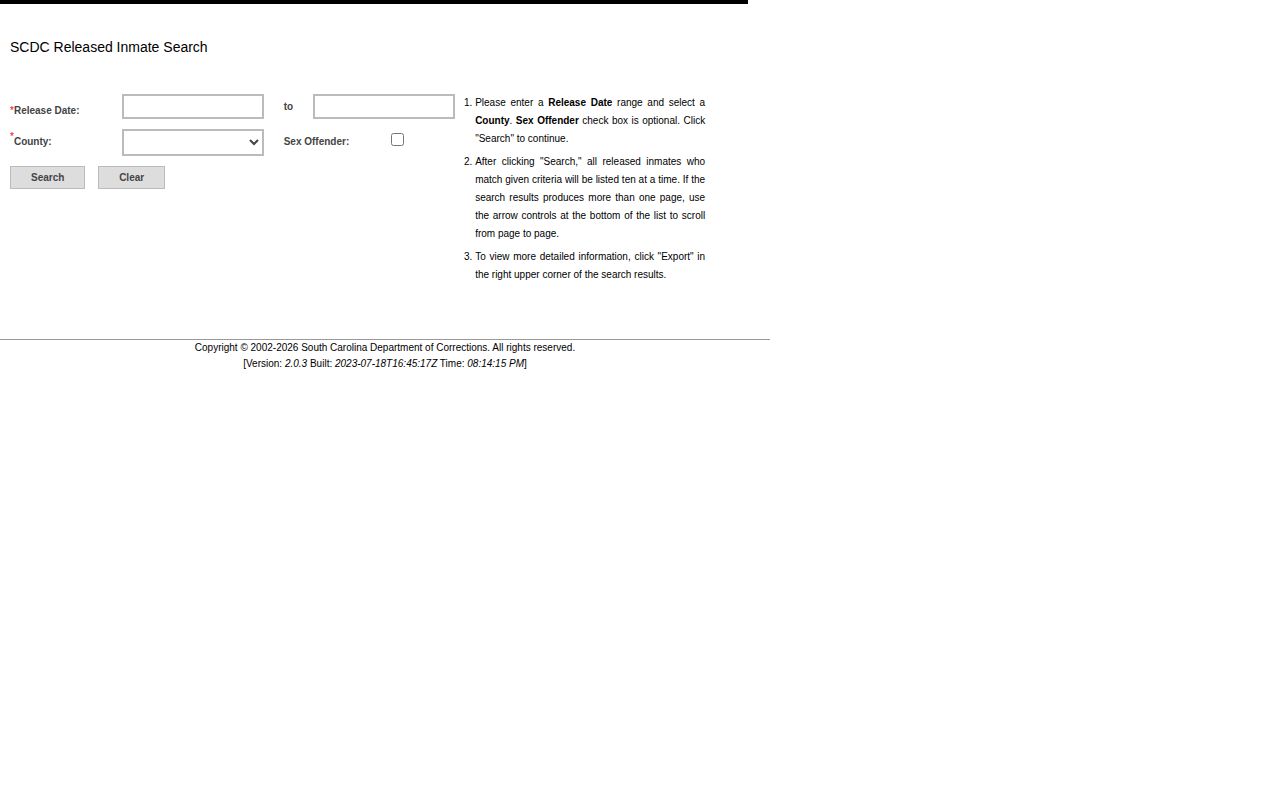
The live form and its current results control. Use Charleston as a county filter only for state-prison releases tied to that field.
A Charleston VINE inmate check can provide a custody-event alert. Confirm the alert against the county or state source. VINE does not compute a sentence and can also announce a transfer, so always read the event and location.
Charleston Parole Eligibility Dates
Parole eligibility is not discharge. Sections 24-21-610 and 24-21-635 contain offense-specific rules, including one-third or a longer mandatory minimum for specified violent terms, one-quarter for other eligible crimes, and ten-year formulations for applicable life or long terms. Eligible earned-work credit can count toward parole eligibility. Good-behavior credit does not.
No-parole offenses, murder, armed robbery, drug trafficking, repeat violent rules, and offense-date provisions can override a general fraction. A scheduled hearing means the board may consider the case. Even a grant must be followed through release processing, conditions, and the final SCDC release record. Use PPP's person-specific hearing result and the official sentence calculation instead of announcing a generic percentage date.
South Carolina Release Calculator
The public SCDC release-date calculator is an educational estimate. Accept its disclaimer, enter only facts supported by the judgment, and preserve the inputs. Then label the result as an earliest-possible estimate made on that date. It is not a live correctional record.
The official calculator view captured for this project shows its disclaimer and input screen.
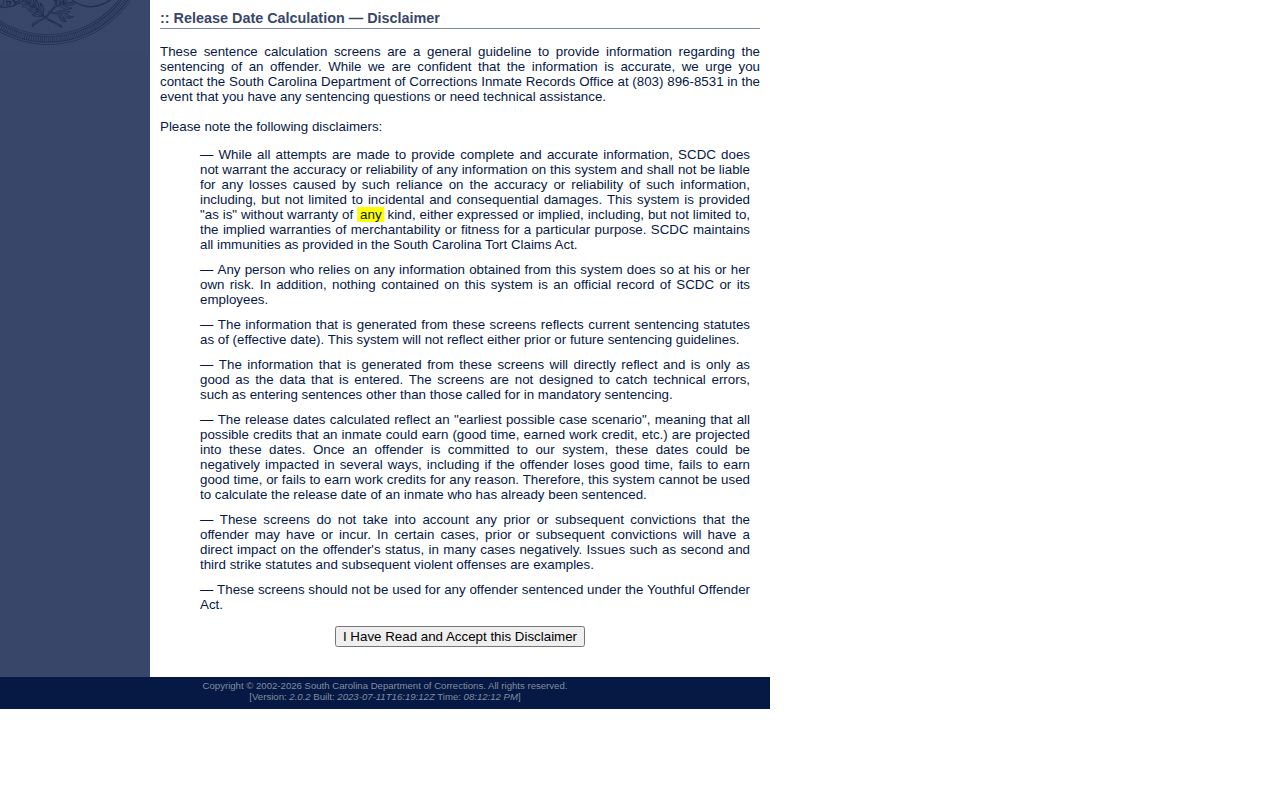
The live agency page controls if its wording or fields differ from the captured view. Never substitute a calculator result for SCDC Inmate Records.
Charleston Weekend Release Dates
No official South Carolina statute or SACDC practice was verified that moves a Sunday release to Friday. No official county weekend or holiday release timetable was found either. Do not infer a special adjustment from common practice elsewhere.
Check the agency record near the expected date and again after the event. SACDC property authorization windows are separate from inmate-release processing and cannot establish an exit time. If timing remains unclear, call detention Records and ask whether the date is scheduled, estimated, or actual.
Note: A projected date near a weekend should be confirmed with the holding agency rather than shifted by an assumed local rule.
Charleston Release Calculation Records
Keep the judgment, sentencing sheet, commitment, jail-credit entries, SCDC identifier, and each dated sentence calculation together. A change is easier to trace when the old and new inputs can be compared. For parole, add the person-specific hearing result. For a detainer, record the issuing agency and any destination stated in the custody record.
If the online data conflict, ask the agency to explain which document controls and whether a correction is pending. A court clerk can provide the filed order but does not perform SCDC's live credit calculation. SCDC can explain its computation but cannot rewrite the judgment. SACDC Records handles the county custody segment. Keeping those roles separate prevents an estimate from being repeated as an official Charleston County release date.
A narrow records request should describe the calculation at issue. Give the full name, SCDC or inmate number, sentence and custody dates, and the date shown in the disputed result. Ask for the sentence computation, credited custody time, earned-credit entries, and actual release or discharge record as applicable. An agency can only provide fields it maintains, and protected material may be withheld or redacted.
For a SACDC matter, compare the booking record with the General Sessions, Summary Court, municipal, or other court channel named in the case. Charleston's court systems do not all hold the same matters. A missing General Sessions entry does not prove the sentence or release date is wrong. Follow the case number and court assignment from the booking record, then request the filed order from the correct clerk. This creates a traceable path from legal authority through custody calculation to the completed release event.