
Charleston Parole and Probation
Parole and probation can look alike after a person returns to the community, but they begin in different ways. Parole is conditional release from a prison term after action by the South Carolina Board of Paroles and Pardons. Probation is imposed by a court, often instead of all or part of incarceration. The South Carolina Department of Probation, Parole and Pardon Services, commonly called PPP, supervises both in Charleston County. A person can also serve community supervision required by statute after a no-parole offense. That is distinct from ordinary parole eligibility.
The Charleston County jail record answers whether someone left Sheriff Al Cannon Detention Center. It does not establish the terms of community supervision. A sentencing order, PPP record, or parole-board result supplies that part of the history. If a person moved from SACDC to SCDC, the county release may only document a transfer. State custody and any later supervision must then be checked through SCDC and PPP.
| Record type | How it begins | Best confirmation |
|---|---|---|
| Parole | Conditional release from an eligible prison sentence after board action | PPP offender search, board result, and SCDC release record |
| Probation | A criminal court orders community supervision | Court sentencing order and PPP confirmation |
| Community supervision | Statutory supervision may follow a no-parole sentence | SCDC release data, judgment, and PPP record |
A discharge ends the supervision term. It is not the same as release from jail or prison. Until discharge is confirmed, a past custody release date alone cannot show that supervision has ended.
- Parole
- Conditional release from an eligible prison term under board-approved conditions.
- Probation
- A sentence served in the community under court and PPP conditions.
- Absconder
- A person alleged to have stopped reporting or left supervision without authorization.
- Discharge
- The formal end of custody or supervision, as shown by the responsible agency record.
Check Charleston Post-Release Supervision
Start with identity, not status. PPP's public Offender Search may return a photograph, name, SCDC or SID number, physical description, birth date, current supervision status, office, and supervising agent. The public data are supplied by the person or gathered during supervision, and some details may not be independently verified. Compare several identifiers before treating a result as a match.
- Search by the person's full name. Use the SCDC or SID number when known because it is more precise.
- Compare the photograph, birth date, physical details, and identifiers. Do not rely on a shared name.
- Read the supervision status, assigned office, and agent fields shown in the live result.
- Call the listed office for same-day confirmation, especially if the status is unclear or an urgent legal process depends on it.
- Compare probation with the sentencing order. For parole, compare the board result and SCDC release record.
The official PPP search supplied this captured view of its public supervision interface.
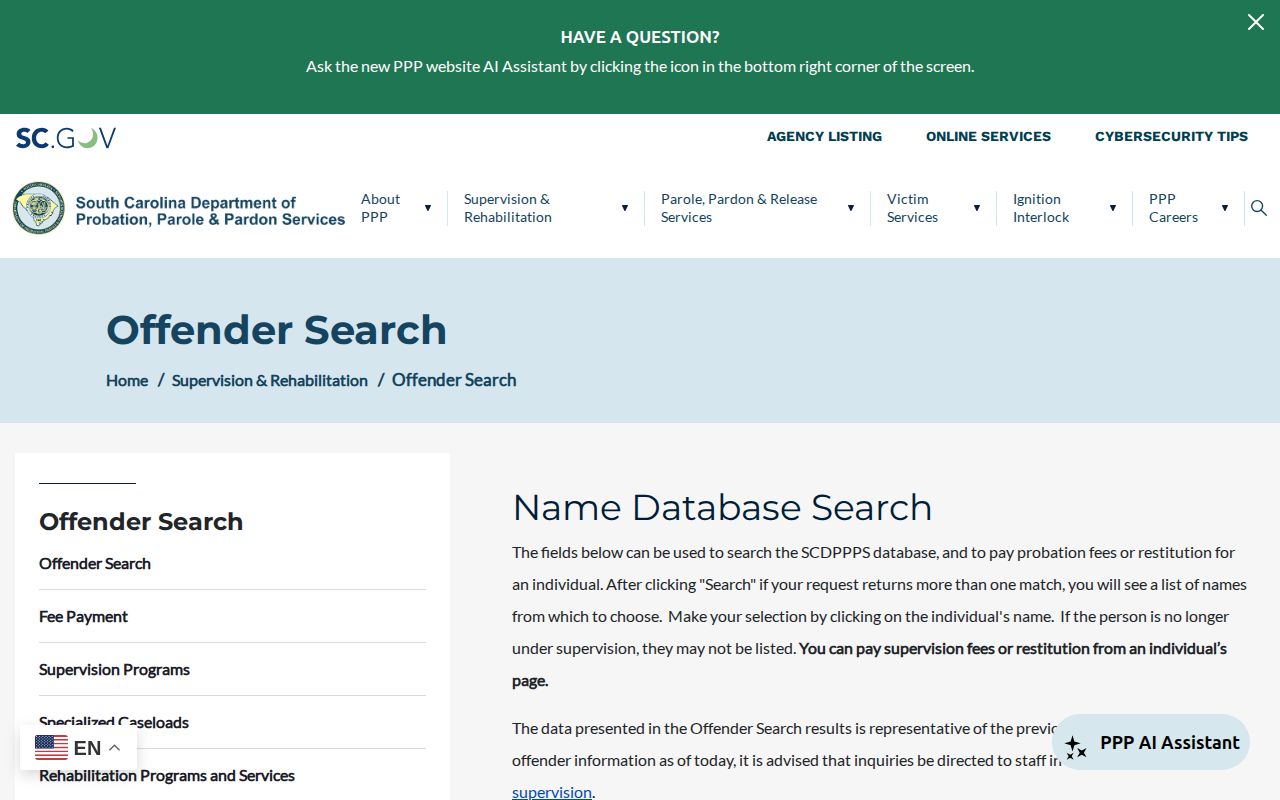
Use the live PPP page for current fields and status because the captured screen is a point-in-time reference.
No result does not prove that the person has no supervision. The name may differ, the record may be delayed, the term may have ended, or the matter may belong to another state or federal agency. Federal supervised release is administered by U.S. Probation and is verified through the federal judgment and docket, not PPP.
Note: PPP says public offender-search information is not an official record, so confirm important status questions with the assigned office.
Charleston Supervision Office Records
PPP lists a Charleston County office for local parole and probation supervision. It is the practical contact when the online result identifies that office or when a current status needs clarification. The directory reviewed for this project did not state public office hours, so call before visiting. Staff may need a full name and SCDC or SID number to locate the right record.
PPP Charleston County
1357 Remount Road, Suite 7
North Charleston, SC 29406
Phone: 843-740-1553
Fax: 843-740-1567
Hours: Not stated in the reviewed directory
The local office confirms active supervision. Board hearing questions go to Parole and Pardon Services at 803-734-9220 or paroleandpardonservices@ppp.sc.gov. Court clerks remain the source for a probation sentencing order, while SCDC maintains the state-prison release record.
Charleston Supervision Conditions
Conditions are the rules attached to parole, probation, or community supervision. The precise terms come from the court, parole board, and PPP supervision record. They may include reporting or other conduct requirements, but a public search summary should not be treated as the full order. Ask the supervising office or obtain the controlling court document when exact terms matter.
An alleged violation can lead to a warrant, hearing, revocation, or a return to custody. Revocation means supervision is withdrawn after the required process. The person may then appear in a new SACDC booking, an SCDC custody record, or a court proceeding. Those are separate records from the earlier Charleston County release. A VINE custody notice may report the later event, but it does not explain the full supervision decision.
PPP's public information includes a Most Wanted Offenders route. Treat it as a lead requiring confirmation. A reported absconder status does not, by itself, state where the person is now or prove current jail custody.
Charleston Parole Hearing Records
The seven-member South Carolina Board of Paroles and Pardons grants or denies parole and can revoke, modify, or rehear a parole matter. Its Parole, Pardon and Release Services search accepts published combinations of first and last name, SCDC number, and hearing month. PPP says a person's date generally appears about 30 days before the hearing after schedules are final. Dates and posted results can change or lag.
The annual calendar is only a planning frame. It does not prove one person's hearing date. Search the person and month, then check again for a result. Official materials support granted and denied outcomes. A denial may lead to another hearing in one or two years based on offense date and classification. A grant is also not the final release record. The physical release still must be completed and confirmed through SCDC's released list.
The official board search page is shown in this saved interface image.
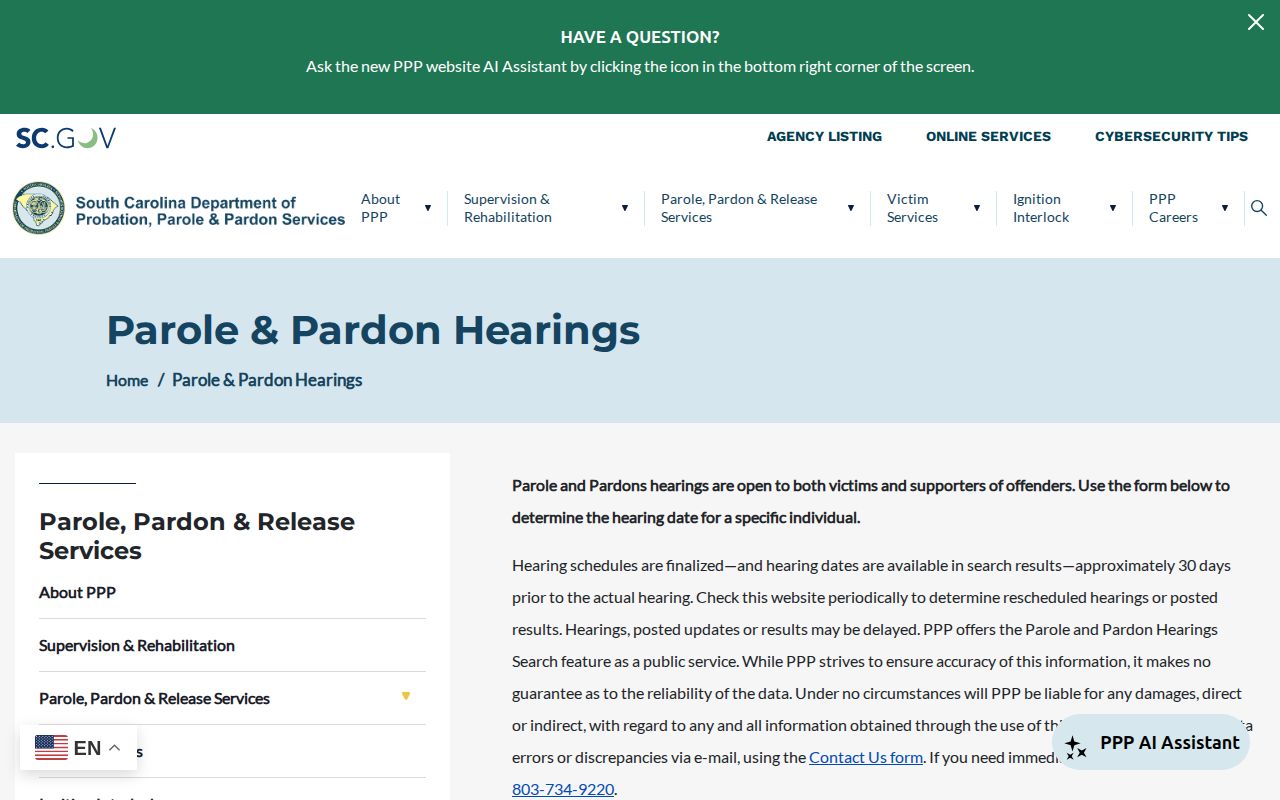
The current person-and-month result controls, not the static image or annual calendar alone.
Parole eligibility is case-specific. Sections 24-21-610 and 24-21-635 include different rules for violent and other eligible offenses. No-parole offenses and special rules can displace the general fractions. Good conduct does not advance parole eligibility, while eligible earned-work credit may count. The offense date, conviction, and sentence all matter.
Charleston Reentry After Release
Sheriff Al Cannon Detention Center added a second re-entry specialist in 2025, according to the sheriff's operational update. Charleston also has PIER, a long-running collaboration among the detention center, Bond Court, and Charleston Center. The county describes about 12 weeks of program involvement followed by outpatient care at no added cost.
These services can help someone navigate treatment and community return. They do not prove that a named person was released, enrolled, or remains under PPP supervision. Use the custody record for release and PPP for supervision status. Program participation is a separate record with its own access limits.
Property Before Charleston Release
A SACDC resident can authorize another person to receive valuable property or cash with a signed Valuable Property/Cash Release Form. The sheriff lists two daily authorization windows: 7:30 a.m. to 4:30 p.m. and 7:30 p.m. to 4:30 a.m. Money is issued by check in the resident's name, and restrictions may apply after an account transaction. Bondsman and attorney situations have separate treatment.
These are property-release procedures. They are not inmate-release times, and they do not show when parole or probation begins. Exceptional after-hours property handling needs command approval. Keep the property form apart from the release record, court order, and PPP supervision record.
Charleston Warrants and Supervision
The CCSO warrant search warns that its data are not an official record and do not confirm that a warrant remains active. PPP's wanted listing has a similar limit as a verification tool. Either may flag a possible supervision issue, but neither proves that someone has been arrested or returned to SACDC.
Confirm a warrant through the responsible law-enforcement unit and confirm parole or probation status with PPP. If the person is booked again, compare the new inmate number, booking date, charges, and court case. Do not merge the new custody event with the old release solely because the names match.
Note: A supervision violation, warrant, arrest, and revocation are distinct events and may appear in different agency records.
Charleston Supervision Discharge
Supervision ends through a formal discharge, not merely through the passage of an expected date. PPP is the source for its own completion record. A court order may also matter in probation, and SCDC records establish the prison discharge or release event. Ask for the document that states the effective date and status when the online result is incomplete.
The Charleston County released-inmate search path explains how the jail release record, court docket, and state corrections record fit together. Those sources establish custody changes. They should then be paired with PPP confirmation to tell whether supervision continued after release.
South Carolina public-record law does not make every supervision detail public. Protected victim data, medical information, sealed or expunged material, and court-restricted records can be withheld or redacted. Request the narrow status record needed and ask the office what is releasable.
For a clean Charleston County supervision timeline, save the original sentencing order, the jail or SCDC actual release record, the PPP search result, and the final discharge document. Each answers a different question. The court establishes the sentence, the custodial agency records the physical release, PPP documents supervision, and discharge closes that supervision term. If dates conflict, contact the agency that created the disputed field and provide the person's identifying number rather than asking another office to interpret it.